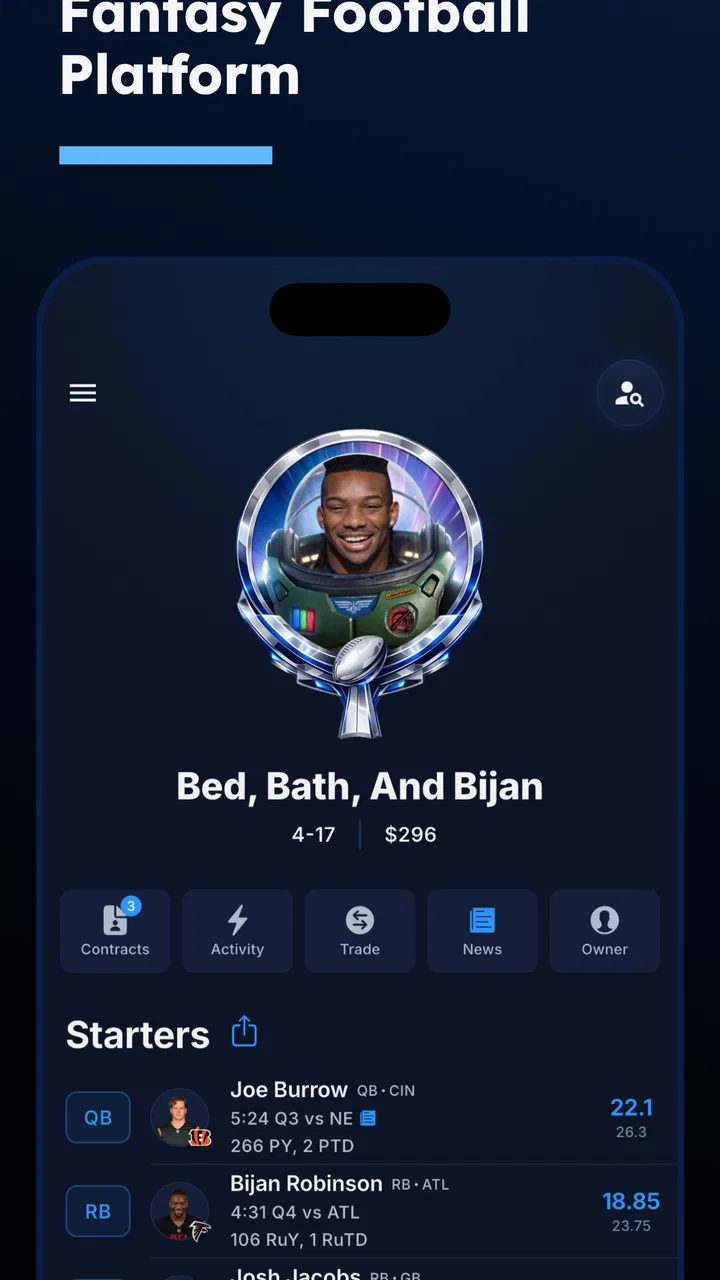
League Tycoon Fantasy Football
- 4.7
- Rating
- 10.00K
- Installs
- Free
- Price

 Analysis by App-foxy
I approached League Tycoon Fantasy Football as a game for people who enjoy the management side of sports more than simply watching a match unfold. Its focus is dynasty-league play, so the appeal is in building something that lasts, making decisions with future consequences, and staying involved with a group over time. That makes it a very different experience from a quick arcade football game or a traditional single-season fantasy contest.
My first impression was that the game is easiest to appreciate when everyone using it understands the same league expectations. It can work well on a shared household device, especially when two or more people take turns checking their teams, discussing choices, or preparing for the next decision. However, it is not the kind of title I would hand to a child and assume the whole experience would make sense without guidance. The game sits close to real sports-management habits, including planning, negotiation, and responsibility for a team over an extended period.
How League Tycoon fits into a shared household
The most natural household scenario is a small group of football fans sharing a tablet or phone during the week. One person can review the state of a dynasty team, another can look over a rival roster, and everyone can talk through what should happen next. That rhythm feels more suitable here than passing the device around for a few minutes of instant action. The enjoyment comes from returning to the league, remembering previous choices, and seeing whether a longer plan is working.
You May Also Like

 Blood Strike: 2.5 Anniversary
Blood Strike’s Loadouts Turn Every Drop Into a Tactical Gamble
A close look at Blood Strike’s custom loadouts: how fast access to signature weapons reshapes its battle royale rhythm, rewards preparation, and narrows the gap between fights.

 Pandora - Music & Podcasts
Pandora’s Music Is Easy to Start, but Harder to Recover
Pandora’s strength is its low-effort path from a seed to a station. Its weak spot is how much confidence it asks you to place in connection, setup, and quiet recovery.

 8 Ball Pool
 Is Built on Rivalries, Rematches, and Routine
A close look at the rivalries, rematches, shared routines, and unanswered safety questions that turn a quick pool match into a persistent mobile community.

 Samsung Music
’s Quiet Strength Is Playing What You Already Own
Its reach comes less from spectacle than from dependable access to a personal library. That simplicity is both the app’s strongest retention engine and its ceiling.

 AccuWeather: Weather Radar
AccuWeather Review: A Quick, Clear Forecast for Everyday Decisions
For everyday plans, the best forecast is the one you can understand quickly. AccuWeather makes rain timing, radar, and local conditions easy to act on, with a few trade-offs.

 Hill Climb Racing
Why Hill Climb Racing Still Turns Crashes Into One More Run
A tiny car, a bumpy hill and one more upgrade: Hill Climb Racing keeps resurfacing because its simple chaos makes every near-miss feel personal.
More From Our News Desk



I also found that the game encourages a useful separation between playing time and discussion time. A household might check the game after dinner, make notes about possible moves, and then leave the actual decisions until everyone has had a chance to speak. This is a better approach than treating every visit as a race to tap first. Dynasty play naturally rewards patience, and a shared device can make that patience visible because each person has to respect the next player’s turn.
That said, the game is not a substitute for a family board game with simple rules and immediate feedback. Younger players may be interested in the football theme but lose patience if they expect constant action. I would recommend it more confidently to households with at least one person who already enjoys fantasy football, roster building, or sports discussion. For those players, the slower pace is part of the attraction rather than a problem.
A practical routine helps. I would choose one regular time to review the league, keep each person’s notes separate, and avoid making decisions while another player is still using the device. Even without assuming any special household controls, those small habits reduce confusion. They also protect the quality of the league, because a dynasty decision can feel unfair if someone accidentally changes the wrong team or acts while another person is still thinking.
Keeping identities separate on one device
Shared use brings up an important question: how do you know which person is making a decision? The safest answer is to establish a clear household rule before starting. Each player should use only their own account or profile area when the game offers one, and nobody should make changes inside another person’s space. I would not rely on memory alone, especially if several people are checking the same phone in a hurry.
It is also worth agreeing on who is allowed to handle purchases. The game is free to download, but it includes optional purchases priced from $11.99 to $59.99 per item. That is a meaningful boundary on a shared device. I would make sure every adult and child understands that installing the game does not mean every in-game purchase is automatically approved. A household conversation before play is much better than trying to resolve an unexpected charge afterward.
This is one area where League Tycoon demands more household discipline than a simple offline sports game. A shared device can blur the line between casual browsing and a real account action. I would keep the device’s purchase approval process under an adult’s control and ask younger players to stop before any payment screen. That is not a criticism of the football-management idea; it is simply the sensible way to handle a free game with optional paid items.
Another useful boundary is deciding whether everyone is allowed to read every team’s information. In a friendly family league, complete openness may be part of the fun. In a more competitive group, players may prefer to inspect their own plans privately. The game can only be enjoyable if the household agrees on this point instead of leaving it to assumptions. I would settle the rule at the beginning and keep it consistent throughout the season.
Coordination matters more than quick reactions
League Tycoon works best when players coordinate around a shared schedule. A dynasty league is not something I would treat like a one-session challenge. The household should decide when reviews happen, how much time each person gets, and what happens if someone is away. These details may sound ordinary, but they prevent the most common shared-device problem: one player moving ahead while another has not had a fair chance to respond.
For a realistic weekday example, imagine two adults and a teenager following one league. The adults might check the game during lunch, while the teenager uses the shared tablet later in the evening. Instead of making an immediate move simply because the device is available, the household could use a short written note saying whose turn it is and what still needs discussion. That turns the game into a cooperative routine rather than a scramble for access.
I would also separate advice from authority. A family member can suggest a roster decision without taking control of another player’s team. This distinction is especially important when an experienced fantasy-football player shares a device with someone learning the genre. Helping someone understand a choice is enjoyable; making the choice for them removes the ownership that makes dynasty play satisfying.
One of the more useful ways to play is to keep a simple decision log outside the game. Record why a choice was made, what the player hoped would happen, and when the group plans to review it. This is not a feature claim about the app; it is a practical workflow that makes long-term play easier. It also gives newer players a way to learn from earlier decisions instead of hearing only that a move was good or bad.
Coordination becomes even more important when the game is used by people who do not live together. A household might begin the league together and later include friends, relatives, or classmates. In that situation, I would agree on communication channels and deadlines before anyone makes a commitment. League Tycoon is more appealing to organized groups than to players who want every rule handled instantly by the game itself.
Age, trust, and the right kind of supervision
The content rating is Everyone, which makes the football theme broadly approachable. Still, an Everyone rating does not mean every child will understand the responsibilities surrounding a shared league or optional purchases. I would feel comfortable introducing the game to a younger player alongside an adult, particularly when the adult explains account boundaries and the difference between a game decision and a payment decision.
The trust issue is less about the sport and more about access. If a child uses the same phone as a parent, the parent should show exactly where the child may play and where they must stop. If several siblings share a device, they should know whose team is open before touching anything. These are simple rules, but they matter more in a management game because a single mistaken action can affect a longer-running plan.
I would not recommend unsupervised shared use for a child who is still learning how digital purchases work. The game is free, yet the optional items create a clear reason for adults to stay involved. A child who understands that free installation and paid extras are separate can enjoy the game responsibly. A child who tends to tap through unfamiliar screens should use it only with an adult nearby.
There is also a social side to age suitability. Dynasty football can involve disagreement, and household players should be ready to accept that another person may choose a different strategy. Adults can make the experience healthier by treating mistakes as part of learning rather than turning every decision into a contest. If the group cannot disagree without pressure or teasing, a solo sports game may be a better fit.
For adults, the trust question works in reverse as well. If a shared tablet belongs to a family, everyone should know who is responsible for purchases and account changes. I would avoid leaving the game open on a screen where another person might continue by accident. A quick sign-out or handover routine, when available, is worth the few extra seconds.
What the game does well for dynasty-minded players
The strongest quality is its clear identity. The store summary describes it as being built for dynasty leagues, and that focus sets it apart from fantasy games designed around short competitions. I like that the premise points toward continuity: your choices are meant to matter beyond a single burst of attention. Players who enjoy constructing a team over time will find more to think about than players who only want immediate match action.
The game also has a useful social advantage in a household. Because the subject is familiar, it can start conversations between people with different gaming habits. Someone who rarely plays games may still want to discuss football strategy, while a regular mobile player may enjoy organizing the league. That makes it a good bridge between sports conversation and interactive play.
Its audience response is encouraging, with a 4.7 average from around 544 ratings and more than 10K installs. I would treat that as a sign that the focused concept works for a meaningful group of players, not as proof that it suits everyone. The relatively specialized dynasty angle remains the deciding factor. If that style of fantasy football is not appealing, a strong average rating will not change the basic mismatch.
Figment Labs has kept the game available as a free sports title, which lowers the barrier to trying it with a household group. That is useful when several people want to see whether the format fits before committing to a regular league routine. The purchase range means I would still approach the free entry point carefully, but being able to begin without an upfront price makes experimentation easier.
Where it may frustrate you
The same long-term focus that attracts dynasty players may frustrate anyone looking for a quick, self-contained session. A casual sports fan might open the game expecting instant excitement and instead find that the meaningful part is planning around a continuing league. I would choose a faster football game for short breaks, direct competition, or action that does not depend on remembering earlier decisions.
Shared-device play can also expose weaknesses in organization. If players do not agree on turns, the game may become less enjoyable even when the underlying sports decisions are interesting. The app cannot replace household communication. A group that wants automatic boundaries, simple child profiles, or a completely hands-off account arrangement should investigate those needs separately before making it the center of family play.
The optional purchase range is another consideration. Free access is helpful, but a household should not treat paid items as an invisible part of the experience. I would begin with a clear no-purchase trial period, then decide together whether anything else is worthwhile. This approach keeps the focus on the game’s dynasty management rather than on spending.
There is also a learning curve in the concept itself. A person unfamiliar with dynasty leagues may need explanations about why a decision matters later or why patience can be better than chasing an immediate result. That is not necessarily a flaw, but it means the game is more welcoming when an experienced player acts as a guide. For a group with no interest in learning fantasy-football conventions, a simpler sports title will probably be more enjoyable.
Device expectations and everyday fit
The listed minimum operating-system requirement is Android 7.0, so owners of older Android devices should check compatibility before planning a shared setup. The current version is 7.2.17, which tells me the game has an established release history rather than being a brand-new experiment. I would still install it on the device that the household actually intends to use, because the experience of sharing a small phone can be very different from using a larger screen.
A larger shared screen is preferable for discussion. When two people are reviewing a team together, cramped viewing can encourage one person to take over simply because they can see the details more easily. A tablet or comfortably sized phone makes the handoff clearer. I would also keep the device charged before a scheduled league review; stopping halfway through a decision is a small annoyance that can disrupt the group’s rhythm.
The game’s sports category may make it sound suitable for every football fan, but its real fit is narrower. I would recommend it to someone who enjoys league continuity, planning, and talking through choices with others. I would skip it for someone who wants a visually immediate football experience, a short puzzle-like session, or a game that works without any social coordination.
My household verdict
After looking at how it works as a shared experience, I see League Tycoon as a good choice for an organized household of football fans rather than a universal family game. Its free starting point, Everyone rating, and focused dynasty identity make it approachable, while the optional purchases and account boundaries require adult attention. The best results come from agreeing on turns, keeping identities separate, and treating decisions as the responsibility of the player who makes them.
I would recommend it to a family or group that already enjoys discussing fantasy football and wants a continuing project to revisit. I would especially recommend using a simple review schedule and an outside decision note, because those habits make the long-term format easier to manage on a shared device. They also give new players room to learn without being pushed aside by the most experienced person.
I would pass on it if the household wants instant action, completely private solo play, or a game with no need for purchase conversations. In those cases, a conventional football action game or a simpler fantasy title would be a better match. For the right group, though, the real strength is the shared planning around a lasting league, not rapid-fire entertainment.
My final view is positive but specific: League Tycoon Fantasy Football is worth trying when dynasty management is the reason you want to play. Figment Labs has built its appeal around a niche that rewards patience and coordination. Used thoughtfully, it can turn a shared phone or tablet into a regular sports discussion point. Used without clear boundaries, it can create confusion over turns, accounts, or purchases. I would install it for a football-minded household, set the rules first, and then give the league enough time to show whether its slower strategy suits everyone.
FAQs for League Tycoon Fantasy Football
01What is League Tycoon Fantasy Football?
League Tycoon Fantasy Football is a fantasy sports management game where you create and manage your own football team. You typically choose a squad, make tactical decisions, compete in leagues, and try to improve your results over time. The experience is aimed at fans who enjoy planning lineups, monitoring player performance, and making strategic decisions rather than directly controlling matches.
02How does gameplay work in League Tycoon Fantasy Football?
Gameplay generally revolves around building a competitive roster, selecting a starting lineup, managing transfers, and making decisions before each fixture. Your team’s success can depend on player form, tactical choices, injuries, and real or simulated match outcomes, depending on the app’s current format. New players should expect a management-focused experience that rewards regular attention and long-term planning.
03Is League Tycoon Fantasy Football free to download and play?
League Tycoon Fantasy Football may be available as a free download, but users should check the relevant Google Play Store or Apple App Store listing for the latest pricing information. Free access can include optional in-app purchases, advertisements, premium currency, or paid features. Before spending money, review the purchase descriptions and consider whether the extra content is necessary for enjoyable progress.
04Does League Tycoon Fantasy Football require an internet connection?
An internet connection is likely important for League Tycoon Fantasy Football because team data, competitions, rankings, events, and account progress may need to synchronize with online servers. Some menus or previously loaded information might work temporarily offline, but full functionality should not be expected without connectivity. A stable connection is recommended to avoid missed updates or problems submitting lineup changes.
05Is League Tycoon Fantasy Football suitable for beginners?
League Tycoon Fantasy Football can be suitable for beginners, especially users who enjoy football but have limited experience with fantasy management games. However, newcomers may need time to understand formations, player values, transfers, and league rules. It is best to begin with the tutorial or introductory challenges, avoid spending resources too quickly, and learn how player performance affects results before making major roster decisions.
Pros
- Simple team management makes it accessible for casual fantasy players.
- Player trading and lineup changes add meaningful strategic decisions.
- League competition encourages regular engagement throughout the season.
- The fantasy format offers replay value with different team-building approaches.
- Designed for mobile play
- with short sessions suitable for quick check-ins.
Cons
- Performance may depend heavily on real-world player statistics and updates.
- Advanced fantasy features may feel limited for experienced managers.
- Frequent notifications can become distracting during an active league.
- The player pool may feel less appealing to fans of smaller competitions.
- Some features or content may require purchases or additional in-app spending.

League Tycoon Fantasy Football
Gallery